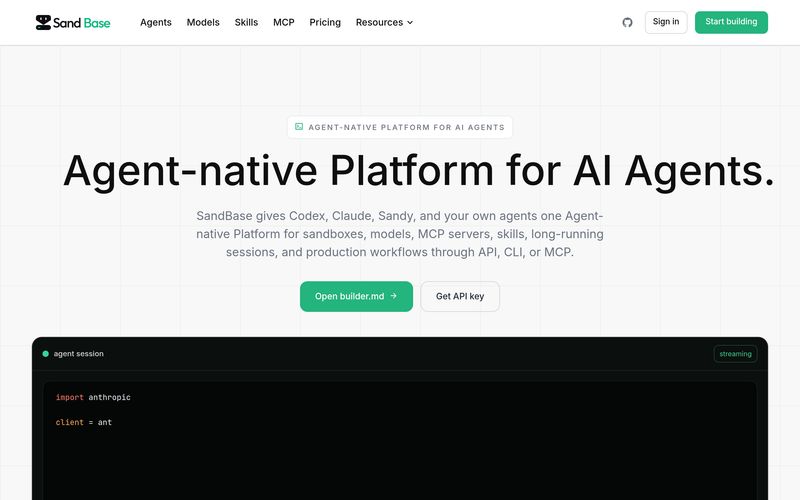
As AI agents become more capable, developers need an efficient way to manage execution environments, models, workflows, and integrations without juggling multiple platforms. SandBase is an Agent-native Platform designed specifically for modern AI Agent Tools, providing a unified runtime where AI agents can be built, tested, and deployed at scale.
Unlike traditional AI infrastructure, SandBase gives developers and AI coding assistants such as Codex, Claude, Sandy, or custom agents a single platform to access sandboxes, AI models, MCP servers, reusable skills, long-running sessions, and production-ready workflows. Whether you're building an application backend, automating development tasks, or creating autonomous AI agents, this AI tool simplifies the entire workflow.
One of SandBase's biggest advantages is its three unified access paths. Developers can interact with the same runtime through API, CLI, or MCP, depending on their use case. APIs are ideal for production applications and backend services, the CLI streamlines terminal-based development, CI pipelines, and AI coding workflows, while MCP enables AI assistants like Codex and Claude to securely access external tools and services. Regardless of the interface, every access method connects to the same underlying runtime, ensuring consistent behavior across environments.
Another standout feature is builder.md, a shared context file that acts as a practical guide for both developers and AI agents. Instead of maintaining separate documentation, builder.md tells Codex, Claude, Sandy, or your engineering team exactly when to use the API, CLI, or MCP interface. It also documents SandBase APIs, CLI commands, MCP configuration, and recommended AI agent patterns, making collaboration between humans and AI significantly more efficient.
Behind the scenes, SandBase delivers powerful runtime services including secure sandboxes, AI models, MCP servers, reusable skills, persistent agent sessions, and full execution traces. These capabilities allow developers to execute isolated workloads directly or run durable AI agents with memory, state management, and production monitoring.
The platform also supports practical production workflows. For example, a user request can automatically create an agent session, process tasks inside SandBase, store results, and generate shareable outputs such as visual cards—all within a seamless end-to-end pipeline. This demonstrates how the Agent-native Platform bridges AI experimentation and real-world deployment.
Overall, SandBase is an impressive AI tool for teams building next-generation AI Agent Tools. By combining unified infrastructure, flexible access through API, CLI, and MCP, persistent agent execution, and AI-friendly development patterns, it provides everything needed to move from prototype to production on a single Agent-native Platform.